2/19/2026 - Others
100 years of the Liechtenstein Persons and Companies Act (PGR)
One hundred years of legal foresight and economic influence.
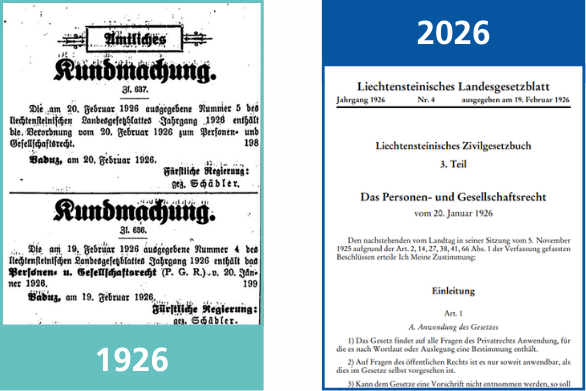
Liechtenstein is marking a very special anniversary in 2026 with the Persons and Companies Act celebrating its 100th anniversary. Since it came into force in February 1926 it has been – alongside tax law – one of the key cornerstones of Liechtenstein’s legal and economic system. Hardly any law has had such a lasting impact on the country’s development as the PGR. At the same time, its entry into force also marked a break with the “Austrian reception” and a turn towards Switzerland.
The PGR – history and enactment
The PGR was enacted during a period of major political and economic upheaval in Europe. Within the space of only four years – and without any legal faculty or existing academic infrastructure – Emil Beck and Wilhelm Beck (who were not related to each other by birth or marriage) were able to create a comprehensive, modern Persons and Companies Act inspired by liberal principles. In a handwritten letter from February 1925, His Serene Highness Prince Johann II expressed his sincere recognition to the “fathers of the PGR” for their services.
The PGR was promulgated on 20 January 1926 upon approval by His Serene Highness Prince Johann II of Liechtenstein and came into force on 19 February 1926 following publication in the Liechtenstein Law Gazette No. 4/1926.
From the outset, the PGR was permeated by liberal ideas. Individual freedom and self-determination not only provided its normative basis, but have also shaped its direction down to the present day. Precisely this openness has proven to be an engine for the development of the Liechtenstein financial centre. In particular the provisions applicable to legal entities, partnerships and cooperatives as well as trusts established a flexible legal framework, providing scope for entrepreneurial action.
Principle and significance for Liechtenstein
The PGR is still the keystone of Liechtenstein’s system of private law. It not only regulates legal relationships between people, companies, foundations and associations and other types of organisation but also embodies core principles on the application and interpretation of the law.
The conscious reception of well-established foreign law – in particular Austrian law (due to historical reasons), later supplemented by Swiss and international influences (for instance Germany) – has always occurred with the Principality’s economic and political framework in mind. In adopting the PGR Liechtenstein was the first continental European country to provide for a vehicle akin to the common law trust. The aim was to create a legal framework attractive for foreign capital, while at the same time offering suitable legal arrangements for the local population and guaranteeing long-term stability. Shortly after its entry into force it was already being referred to in the literature as “Europe’s most modern law”.
Within only the first three years of the entry into force of the PGR, the number of domiciliary companies increased from 68 in 1925 to more than 1,000 in 1928. Economic growth later stagnated as a result of the economic crisis at the end of the 1920s followed by the Second World War. During the post-war period the number of legal entities increased sharply, foreign capital flowed into the country and Liechtenstein started to position itself sustainably as an international financial centre. Soon Liechtenstein had more legal entities than inhabitants.
Its flexibility and adaptability were key factors in the success of the PGR. It has been continuously developed, for instance as a result of adherence to the EEA, the implementation of European directives or the 2008 reform of the law on foundations, which placed governance and supervisory standards on a binding footing. This balance between stability and development still characterises the PGR.
Significance for Allgemeines Treuunternehmen (ATU)
The new opportunities and framework conditions created by the entry into force of the PGR were also recognised at an early stage by our founder, Princely Counsellor of Commerce Guido Feger. During the infancy of the trust sector, he took on responsibility for managing numerous legal entities following the incorporation of Allgemeines Treuunternehmen (ATU) in 1929. Despite the turmoil caused by the Second World War, he was able to maintain existing client relationships and to cultivate contacts under the most difficult conditions – even making client visits, which were anything other than straightforward at the time.
Allgemeines Treuunternehmen (ATU) also benefited from the expansion of the trust sector and the sharp increase in the number of legal entities, in particular during the post-war period. Since it was enacted, the PGR has operated as the core foundation for the professional practice of Allgemeines Treuunternehmen (ATU) and has had a lasting impact on its everyday operations. The legal entities governed by the PGR – including in particular the foundation, establishment, company or trust – allow for the long-term, internationally recognised structuring of assets and corporate relationships with legal certainty.
The Liechtenstein foundation stands out in particular in offering tangibly more flexibility in terms of structure than Swiss and Austrian foundations, and thus clear competitive benefits. The establishment as a legal entity governed by private law also deserves particular attention. Hardly any other legal entity under Liechtenstein corporate law offers as much flexibility and versatility. Depending upon how it is structured, it combines elements of the law applicable to foundations and company law, and stands out in particular due to the rigorous separation between control rights and property rights. However, the focus has not been solely on the development of new legal entities, as traditional models such as the cooperative have also been proactively enhanced. Within the current manifestation as the Liechtenstein Venture Cooperative (LVC), it offers new, contemporary opportunities in terms of applications.
Even 100 years ago, Liechtenstein was already particularly far-sighted. It was the only country in continental Europe to have codified the trust into law, thereby intentionally opening up its national legal system to international structures and needs. At the same time, the PGR was and is constantly being adapted in line with international standards – for instance in the areas of transparency, the combatting of money laundering and governance. This ongoing development makes it clear that it is not a relic of past times but rather a living framework of modern legal design, which has repeatedly reinvented and proven its worth over the course of a century. For ATU, the PGR symbolically represents continuity, legal certainty and a reliable foundation for supporting clients from one generation to the next. 2029 marks the 100th anniversary of Allgemeines Treuunternehmen (ATU) – a success story that traces its origins back to the entrepreneurial foresight of Princely Counsellor of Commerce Guido Feger and has flourished on the stable foundation provided by the PGR.
Book: “100 Jahre liechtensteinisches Personen- und Gesellschaftsrecht im Dialog” (“Dialogue on 100 years of the Liechtenstein Persons and Companies Act”)
To mark the anniversary, on 19 February 2026 the Liechtenstein Business Law School presented the interdisciplinary anniversary volume entitled “100 Jahre liechtensteinisches Personen- und Gesellschaftsrecht im Dialog” at the University of Liechtenstein auditorium.
The volume supplements the commemorative legal publication from January 2026 and intentionally casts its gaze beyond the classic company law. It highlights interdisciplinary interactions, amongst other things with criminal law, banking and financial markets law as well as philanthropy, thereby reflecting the breadth of the Liechtenstein legal system.
We are particularly proud that Allgemeines Treuunternehmen (ATU) is represented in this volume with an article by lic. iur. Märten Geiger LL.M. entitled: “Die Bestimmungen zum Genossenschaftsrecht im PGR: Ein Rechtsgebiet mit unterschätzter Bedeutung” (“The PGR provisions on the law applicable to cooperatives: a legal field of underestimated importance”).
The anniversary volume can be ordered directly from the publisher Dike (only available in German):
https://www.dike.ch/butterstein-gottschald-burtscher-papathanasiou-wenz-100-jahre-liechtensteinisches-personen-und-gesellschaftsrecht-im-dialog
Conclusion
A century after its entry into force, the PGR stands for legal certainty and economic ingenuity now more than ever. It has not only left its mark on Liechtenstein but also created a clear position for the country on the international scene. Its particular strength lies in its reconciliation of stability and adaptability. Precisely this balance means that it is still today a reliable foundation for innovation and sustainable development. For ATU, the PGR therefore remains both a mission and an incentive: upholding tradition whilst also actively contributing to shaping the future.